“Manage your expectations”, Cip said before we boarded the
plane that very early morning. We left Jakarta at 2am on a 3 hours flight to
Ternate.
We simply didn’t know what to expect. Yes as usual we
consulted Lonely Planet’s guide. But the one about Maluku that Cip has, did not
have that much either. So he made the itinerary, but a very rough one because
there was no way we could find more information. Googling did not give us much
either.
And so we arrived at 8am (there is a 2 hours time difference
between Jakarta and Ternate – amazing, isn’t it?. You’ve got to travel to the
further points of Indonesia to really understand how vast this country really
is...). The airport looked new. The sky looked promising. And the adventure
began.

Life around a volcano
The first thing that struck me as we got out of the airport,
was a huge wall of rocks right in front of it. Then it dawned on me that we
were not that far from Gamalama, the active volcano sitting almost in the
center of this tiny island.


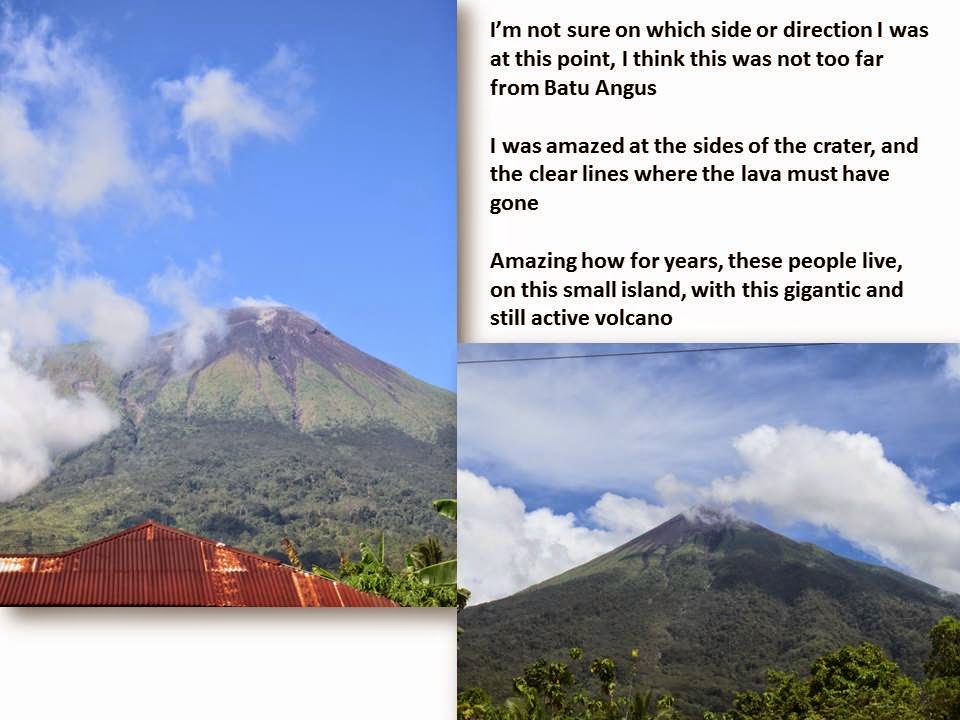
So one thing that is nice to do is driving around the island,
enjoying the different faces of Gamalama as you go.
And of course from Ternate, you can enjoy Maitara and Tidore
with Kiemotabo mountain standing tall. My favourite view of them was in the
early morning – when the sun splashes its many colours onto the slopes of
Kiemotabo.


A history around spices
Being on Ternate also means you’ve got to trace the history.
Ternate was one of the 4 Islam sultanate in the Molluccas,
and one of the oldest. And given its rich spices especially cloves and nutmegs,
in the 15th century, the Portuguese arrived in this land and began trading. Of
course the end game was to rule this island, and had all the spices for
themselves. To cut the story short, the Portuguese played dirty. In an event
where Sultan Khairun who reigned at that time, was invited to Fort Kastela to
sign a treaty but then was murdered, Ternate fought back. Sultan Baabulah, the
son of Sultan Khairun, led the fight. His troops and common people surrounded
the castle, causing the Portuguese to suffer from no food supply. This went on
for 5 years and finally the Portuguese left Ternate. In the 16th century, under
Sultan Baabulla, Ternate was one of the richest sultanate in Indonesia. It
reigned all the way to the North Maluku, even to the Philippines.
What happened in Ternate actually had a very important
impact for Indonesia. After Portuguese left Ternate, for 100 years
colonialization was hindered. I’m not sure how many Indonesians realise this
important fact of the sultanate in this tiny island.
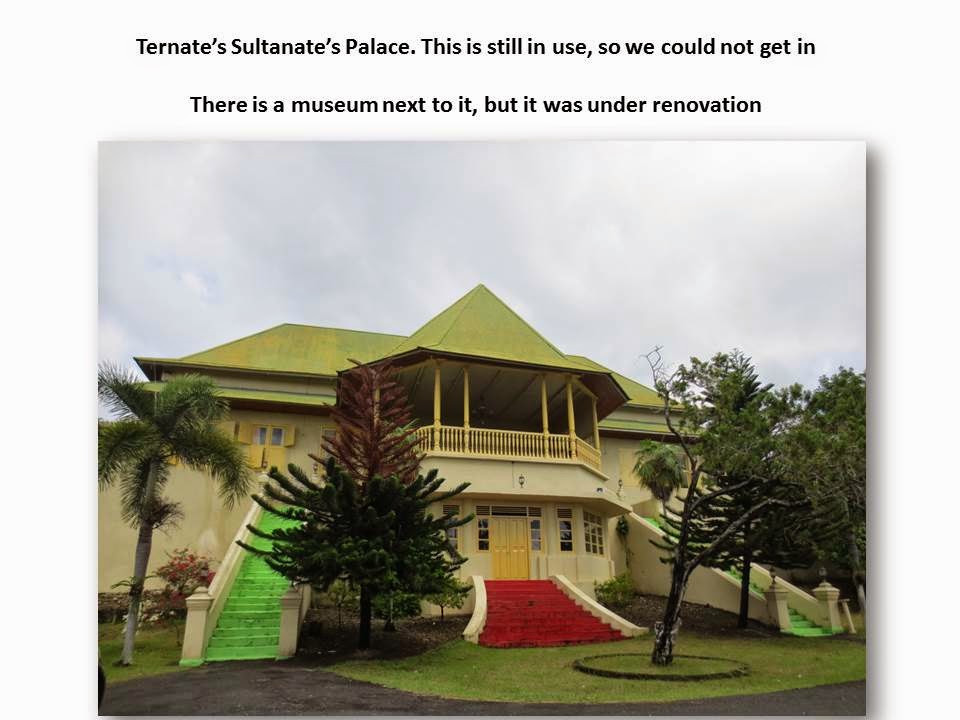
So you can’t just get past these traces of history in
Ternate. There are forts built by the Portuguese, all over Ternate. We tracked
each one of them – I used the word tracked for a reason: there was no sign
anywhere on the road, so we just had to open our eyes to see the sign board
(most of these forts are on the road side), or asked people where they were. But
most of these forts are no longer standing aside from perhaps some parts of it.


A feast to the eyes
Of course, a journey to the eastern part of Indonesia, or
any part for that matter, means you’ll be amazed at what you’ll see.
There are several spots in Ternate albeit its tiny-ness,
that are just amazing to visit and sit there or snorkel there for hours and
hours. We did just that in our 3 nights and 4 days there.


 | |
| Story has it, that this lake is magical that if you throw rocks on it, they won't touch the water. To allow people to proof that, there are kids with catapults that you can 'rent' and they'll also 'sell' the rocks to you. This twin lake also has a story to it. Because there was a sexual relationship between a father and his daughter, God was angry. There was a big quake, and when they tried to escape, the soil where the father stood turned into the Big Tolire, and the daughter turned into the Small Tolire. Story also has it that inside this lake, which until now its depth is still unknown, there is hidden treasure: the various things that Ternateans had and threw here when the Portuguese ruled the land. |




Tidore – a distant cousin
Also an Islam sultanate, in the 17th – 18th century Sultan
Nuku from this sultanate managed to unite both sultanates of Ternate and Tidore
and led the fights against any foreign power trying to conquer them for spice
trading.
And, this is a fact that surprised me: Tidore’s sultanate
reigned all the way to Raja Ampat in Papua!. No wonder the name Raja Ampat does
not sound like Papua’s language at all. And in Tidore there is a village up the
hill of Kiemotabo, that is populated by people from Papua who maintained their
traditional way of life.
We crossed to Rum, Tidore, from Bastiong. There are regular ferries
going from Bastiong to Rum, and vice versa.
Arriving at Rum, we took a public transport to go to Soa Sio
– the capital of Tidore. In Soa Sio, Betor – or Becak Motor, is the easiest
means of transportation that you can hire for as long as you wish.


Halmahera – a truly hidden jewel
If we found it difficult to find information about Ternate,
it was even harder to find one about Halmahera.
We asked the hotel staff (because we did not actually plan
to cross to this island – it was a last minute decision), what we could find in
Halmahera. And they said there were several beautiful beaches. We were thinking
of going to Sofifi – but they suggested to go to Jailolo bay which is closer to
Ternate, and more developed than Sofifi. A fact that somewhat startled us given
the fact that Sofifi is actually the capital of North Maluku.
And we only found out that there is only one ship going to
Jailolo at 830, and one going back to Dufa Dufa at Ternate at 2 – if we wish to
get on the big ship. But there is also an option of speed boat which has a more
flexible timing depending on when the boat is filled – which we were not keen
because we wanted to experience the traditional wooden ship.
So off we went at 830 from Dufa Dufa. It took 2.5 hours to
cross to Jailolo bay. We only spent about 3 hours on this island because we had
to be on board the ship going back to Dufa Dufa at 3. A too short a visit, I
know. But at least, I know where I should go next!.


Having seen parts of West Halmahera, I think my next target is to explore it further, going all the way to Morotai - one of the outer islands of Indonesia. And perhaps, if I've got time, onwards to Raja Ampat.
Next time, yes, next time...