Mamasa was mentioned casually last year when we were roaming
around Toraja. It is described as ‘Toraja’s own backyard’ – with long roofed
houses, and more traditional way of living. That was enough to intrigue me.
After months of planning, and what I thought would never materialize, suddenly there was an open door. A time when I could slip away for some days. And off I went, to Mamasa.
I expected little. I could not find much about this place. Lonely Planet did mention areas of interests. Travelers who went and wrote about it, did not write much, and all were outdated with the ‘newest’ being written in May 2014.
From little information there was, one thing was consistent: the road condition is bad. So for that, I was ready. Traveling to Mamasa from Makassar can take as long as 11 hours thanks to that. That, I was prepared for.
Mamasa is located in the newly formed West Sulawesi province. In the past, Mamasa was one with Polewali – as Polmas (Polewali Mamasa) municipality. In 2011, the government split Polewali and Mamasa, so Mamasa’s become an independent municipality.
In the larger scheme of things, Mamasa is planned to be developed as another source of tourism. With its proximity with Toraja, and similar cultural basis, there is a huge potential for Mamasa to grow. Unfortunately, like many things in this country, things just go too slowly. Until now, very little is known about Mamasa and the main culprit, is the difficult access to come there.
Mamasa is actually well placed in a beautiful valley. That in itself, has given this place a wealth of beautiful landscape. So I read. Almost all of what was written described the view as the main attraction of Mamasa.
Apart from the view, unique traditional houses, traditional woven fabrics, and its coffee, are three other things mentioned again and again.
So I went with 4 expectations: to immerse myself in the beautiful nature, get in touch with its culture – the houses and fabrics specifically, and to have a taste of that coffee (which, with my little knowledge of coffee, I expected to be as good as Toraja’s coffee).
The Challenging Trip
I arrived in Makassar around 11pm. We went straight to Parepare to spend a night before embarking to Mamasa the next day. Looking back, I was glad we made that decision because that gave us a chance to enjoy a peaceful morning and arrived in the afternoon in Mamasa rather than late at night.
After months of planning, and what I thought would never materialize, suddenly there was an open door. A time when I could slip away for some days. And off I went, to Mamasa.
I expected little. I could not find much about this place. Lonely Planet did mention areas of interests. Travelers who went and wrote about it, did not write much, and all were outdated with the ‘newest’ being written in May 2014.
From little information there was, one thing was consistent: the road condition is bad. So for that, I was ready. Traveling to Mamasa from Makassar can take as long as 11 hours thanks to that. That, I was prepared for.
Mamasa is located in the newly formed West Sulawesi province. In the past, Mamasa was one with Polewali – as Polmas (Polewali Mamasa) municipality. In 2011, the government split Polewali and Mamasa, so Mamasa’s become an independent municipality.
In the larger scheme of things, Mamasa is planned to be developed as another source of tourism. With its proximity with Toraja, and similar cultural basis, there is a huge potential for Mamasa to grow. Unfortunately, like many things in this country, things just go too slowly. Until now, very little is known about Mamasa and the main culprit, is the difficult access to come there.
Mamasa is actually well placed in a beautiful valley. That in itself, has given this place a wealth of beautiful landscape. So I read. Almost all of what was written described the view as the main attraction of Mamasa.
Apart from the view, unique traditional houses, traditional woven fabrics, and its coffee, are three other things mentioned again and again.
So I went with 4 expectations: to immerse myself in the beautiful nature, get in touch with its culture – the houses and fabrics specifically, and to have a taste of that coffee (which, with my little knowledge of coffee, I expected to be as good as Toraja’s coffee).
The Challenging Trip
I arrived in Makassar around 11pm. We went straight to Parepare to spend a night before embarking to Mamasa the next day. Looking back, I was glad we made that decision because that gave us a chance to enjoy a peaceful morning and arrived in the afternoon in Mamasa rather than late at night.
 |
| The view that greeted me as I opened the door, in Bukit Kenanga Hotel, Parepare. Ask for a room on the 3rd Floor. The view is worth every single step you take |
The road up to Polewali was good. But soonest we took the turn towards Mamasa, it got very interesting all the way up. If you are not used to having it rough on any road trips, then I would not suggest to consider Mamasa at all in your bucket list maybe for another 2- 3 years. Looking at how slow things have to be done due the difficult terrain they have to deal with, I doubt that a smooth journey is going to be possible in the near future.
The view, however, was really refreshing. As if a consolation to all the rocking and jumping and shaking that we had to experience in the car, for maybe a total of 3 hours soonest we took the turn to Mamasa.
And the more I got acquainted with the road condition, I was even more glad we broke the trip into two by staying in Parepare. It gave us time to enjoy the view slowly, made some stops along the way without worrying that we would arrive after dark with that awful road condition.
We embarked at 8.30am from Parepare, arriving around 4.30pm in Mamasa, giving us plenty of time to enjoy a quiet and cool afternoon at the hotel. If it was a straight journey from Makassar, I’m sure we would have arrived at around 7pm at the earliest – not fun at all.


 |
| Well....those should give you a feel of what kind of road that you will have to go through to come to Mamasa |
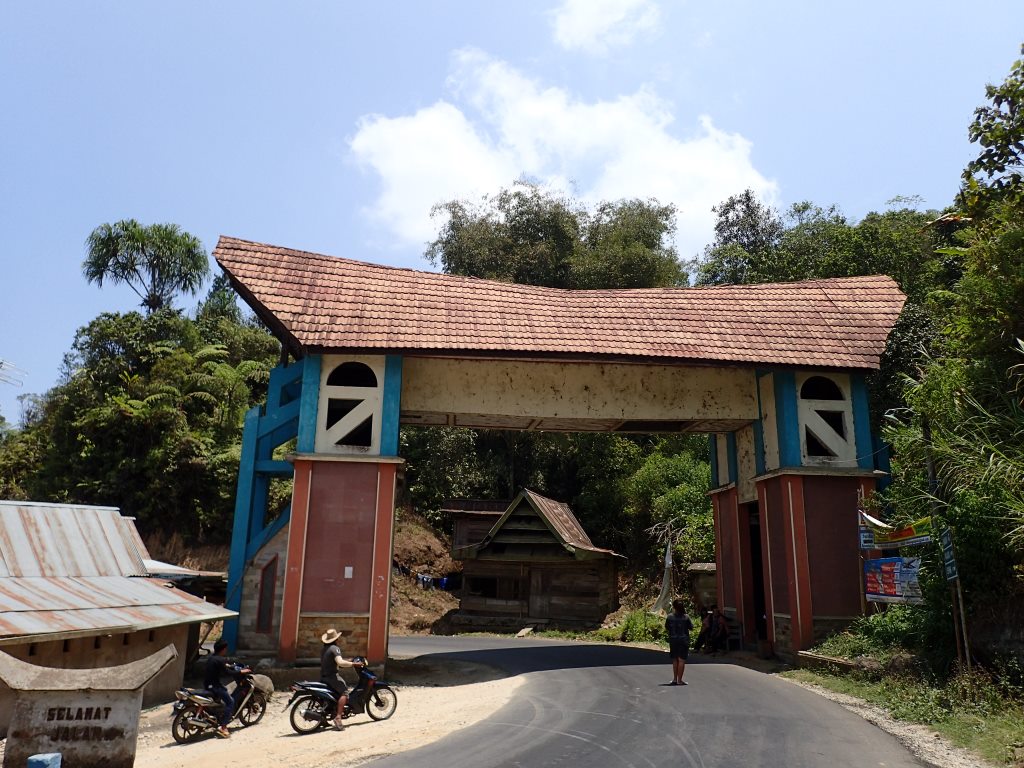 |
| Honestly I was rather glad when I saw this gate to Mamasa. Hoping that the road would get better. Well....apparently one could only wish :) |


 |
| All these are really soothing for the eyes, and all of my muscles. I really recommend the trip to be taken slowly - take some stops along the way. Stop by the small river. By a padi field. Anything to immerse yourself in the beauty of nature regardless the awful road! |
Exploring Mamasa – mind opener in its truest sense
Woke up at 5am. It was 17 degrees Celcius and I had to wear a pair of socks, a jacket, and a sarong to cover myself from the cold. I excitedly waited for the sun to get warmed up!.
It was an experience in itself watching the mist slowly went up as the day got warmer.
 |
| The view from in front of my room, at Matana II Hotel, Mamasa |
We stayed in Mamasa for 4 days. And this is my overall impression:
- Coffee is not good. Regardless of what local people told me that their coffee is aromatic, I really could not say that it was. I suffered for three days. But, that was also an experience to savour!.
- Be prepared to walk – A LOT. Mamasa’s main attraction is to go trekking up the hills. But even when you do not intend to do it, prepare a good pair of walking shoes. Location of one village to the other is quite spread out – as many as 15kms away at some places. There are roads but cars cannot pass through many of those unless maybe a 4WD. So in many cases you can go just as far as the car can go, and continue by walking. You can hire ojek – or motor taxi, this is the main public transportation for people in Mamasa and I am sure they can take you all the way up the hills. But I’m sure it will not be comfortable with the kind of road that you will have to go through.
- Food variety is limited. Unlike in Rantepao in Toraja where you can find many varieties, this is not so in Mamasa. Most warung provides chinese like food, or Coto Makassar, or Mie Titi. So manage your expectations, do not be fussy about food.
- I was told that the weather is the same like Toraja. Stupidly enough, I forgot that in Toraja I stayed in Rantepao which is not too cold. Mamasa is further up the hills – so be ready with a warm jacket especially to prepare you for the night. And some warm socks too.
- What was told to be beautiful traditional woven fabrics and rattan mat that are unique of Mamasa, are no more. People weave when they are asked to – and the types of weaving that they do is also the very basic ones that you can get cheaper in Toraja. They even no longer make their own weaving threads – all use ready to use threads. Rante Sepang and Buntu Balla – which are supposed to be few of the weaving centres, carry the same types of simple woven fabrics which are quite disappointing if you are looking for the more ‘serious’ and traditional ones like I did.
So of all that I expected to experience, I was most happy with the surrounding nature, and the traditional houses.
What has saddened me the most is the disappearance of their traditional weaving activities. I guess the limited access to other places has made it less economical for people to continue making what they used to make with limited number of sales made. Economy value of those has been reduced. And I am sad to know that it is no longer there – another heritage gone, perhaps.
 |
| In the making at Tai Bassi - but not as romantic as I imagined it to be, like what I saw in Sa'dan, Toraja: women producing the threads from cottons, then weaving it carefully with intricate patterns. That is no longer done. |
 |
| The kinds of fabrics sold in their Market Day - which happens every Monday every week |
Beautiful, yet less
romantic, traditional houses of ‘modern’ Mamasa
Mamasa as a tribal group has the same root as the Torajans. But it is naive to think that they are the same because eventhough their language is similar, the words and meanings can be quite different, which I found fascinating.
When it comes to the house, Mamasa’s house main difference with the Toraja’s is its roof. And the roof as well as the existence of (or non-existence of) carvings on the house, differentiate different layers in the society. They have 4 types of houses:
Mamasa as a tribal group has the same root as the Torajans. But it is naive to think that they are the same because eventhough their language is similar, the words and meanings can be quite different, which I found fascinating.
When it comes to the house, Mamasa’s house main difference with the Toraja’s is its roof. And the roof as well as the existence of (or non-existence of) carvings on the house, differentiate different layers in the society. They have 4 types of houses:
- Banua Layuk – layuk means ‘high’, hence banua layuk means a house that is both big and has a high roof. The owner of the house usually belongs to the royal family, or the head of the society.
 |
| Banua Layuk at Rambusaratu - said to be around 400 years old, the roof has given up and changed to an aluminium roof |
 |
| The alang of the banua layuk |


 |
| Another banua layuk, honestly I forgot where this was... |


 |
| Banua is divided into several rooms - unlike Toraja's tongkonan that only consists of three rooms. Every banua is divided into 4 or 5 rooms, including a kitchen at the back |
 |
| The mat is uniquely Mamasa's - which unfortunately is no longer made unless you order one. The quality is so good that it is said to last for years without tear |
 |
| Some houses, but especially the houses that belong to the leaders in the society, will have this 'drum'. It is used to inform the village if there is death in any family living in the village |
 |
| I do not remember seeing any statues like these in Toraja's houses. In Mamasa this is quite common to see - a symbol of their heros or ancestors |

- Banua Sura – sura means carvings. Banua Sura means that the house is decorated with carvings which can cover the whole house, or only parts of it. This also belongs to a leader in the society. You'll notice that the roof is not as high as Banua Layuk. But the carvings exist sometimes till the back of the house.

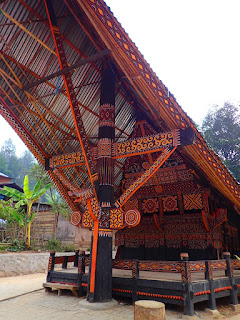

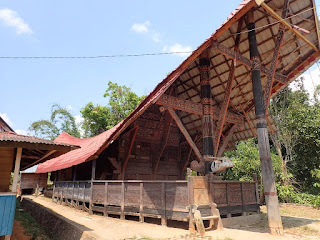


- Banua Bolong – bolong means black. And this house, is painted black. This usually belongs to a rich person, and a hero in the society.
 |
| Banua Bolong, at Balla Peu' |
- Banua Rapa – a simple, not decorated house, and the roof is usually not high. This belongs to the common people.

 |
| Banua Rapa at Balla Peu - one among very few that still have thatched roof made of grass |
While I was amazed to see especially Banua Layuk and Banua
Sura, but I have found something missing from the romanticism that I expected
to experience in a faraway place like Mamasa: the roofs of many of these houses
were no longer made of grass.
According to an ex-head of village that we met at Balla Peu’, grass is more and more difficult to find, so it is now replaced with a regular aluminium roofs which take a lot of its charms away.
According to an ex-head of village that we met at Balla Peu’, grass is more and more difficult to find, so it is now replaced with a regular aluminium roofs which take a lot of its charms away.
 |
| Among a few houses still use thatched roof at Balla Peu' |
 |
| But most of the houses, already use aluminium roofs |
And unlike in Toraja where
there will be a display of buffalo’s horns on the tongkonan’s main pole
to indicate the wealth of the family, in Mamasa such things do not really
exist. Though Mamasa as a tribe has the same root of belief as the Torajans,
but they do not have as heavy tradition as Toraja when it comes to celebrating
death.
 |
| Not often that we see a house with these many horns. Even on Banua Layuk |
 |
| Some will have just these many |
The carvings on Banua Layuk and Banua Sura, are as intricate
as those in Toraja’s tongkonan, with bits and pieces of different patterns that
are quite stunning to see. Some of those, I feel, appear to be quite ancient.
 |
| In Banua Layuk, Banua Sura or Banua Bolong, also on the alang or barn of those houses, we always see these horse head statues. Apparently I later found out this is quite unique to Mamasa. Horses, are considered as the vehicles of the noblemen - so they only exist on houses of these men and their descendants |


Just
like Toraja’s tongkonan, in Mamasa every banua is accompanied with an alang or barn.
However, different from those in Toraja, Mamasa’s alang does not have to be
located vertically against the banua. They can be located by the right side,
left side, or, horizontally in front of the banua.
We tried asking why this is so, but it appears that nobody really knows.
We tried asking why this is so, but it appears that nobody really knows.
 |
| Most of the alang that we have seen are actually placed horizontally, right in front of the banua |

In the bosom of a
beautiful valley
Just like in Toraja, I was awed by what I have seen in this valley. Although, my travel companions kept on saying Toraja is more beautiful :D (well...beauty is in the eye of its beholder. So you can judge for yourself by visiting these places :) ).
Just like in Toraja, I was awed by what I have seen in this valley. Although, my travel companions kept on saying Toraja is more beautiful :D (well...beauty is in the eye of its beholder. So you can judge for yourself by visiting these places :) ).


---
Another
place visited, many things learned, many impressions created. I would say that
this trip opened up a new horizon to me: the fact that Indonesia’s hills and
mountains are so far and away, and access is very tough to these places, can
also mean a risk of losing
our beloved cultural heritage.
our beloved cultural heritage.
I just hope there is not much loss anywhere else. And I hope
I will still have time to explore other places like these...in some other days...
 |
| Hope it gets better with time, without losing too much of itself... |
(R I R I)


